Why It’s Called the Canonica
Readers familiar with earlier Lightspress roleplaying books have asked whether Principia Canonica replaces those systems or renders them obsolete. It comes up after someone notices that earlier books describe action resolution in slightly different ways. In a few cases, it looks noticeably different from the one presented in the new core book. The observation is accurate, but that can lead to a misunderstanding about what's actually changed.
The differences mostly concern the procedure used to resolve actions, and not the underlying structure itself. Earlier work admittedly experimented with a few approaches to turning character intentions into narrative consequences. Some versions emphasized slightly different ways to interpret outcomes, and others presented alternate mechanics to reach the same conclusions. Those variations reflected the evolving design process and refinement through ongoing play and feedback, rather than a shift in a philosophy.
Across all of those books, the central structure has remained stable. Characters are defined through a set of traits rated on the same 1–5 scale. The gamemaster evaluates the situation , and the outcome changes the situation and pushes events forward through consequence. That framework has stayed intact, even when the dice handling procedures change.
Because that structure is consistent, earlier material works with Principia Canonica. Settings, scenarios, and characters built around the trait system can be used without modification. You can use th older procedure, or replace it with the approach described in the new core book. It’s straightforward when you understand the structure and philosophy.
The purpose of Principia Canonica is to remove that sense of edition uncertainty going forward. The title signals exactly what the book establishes: the one-and-only canonical version of the system. This volume defines the version that all future publications will use as their foundation. When a book carries the Canonica label, you can expect it to follow this structure and process.
This edition makes it easier for us to expand the range of material built on the system. Future books will explore different genres and settings, relying on the same underlying mechanics. Campaign settings will offer tools for running specific kinds of stories, and we have plans to build complete games using the Canonica as their foundation. Because the core structure remains consistent, new and old works will remain largely compatible with one another.
But that’s the future. The immediate goal is to establish the canonical system in a clear, and stable, core book. Earlier books still function and the shared framework remains intact. Future material can build on a single version of the rules. Principia Canonica defines the foundation, the common reference point, so everything that follows is consistent and cross-compatible.
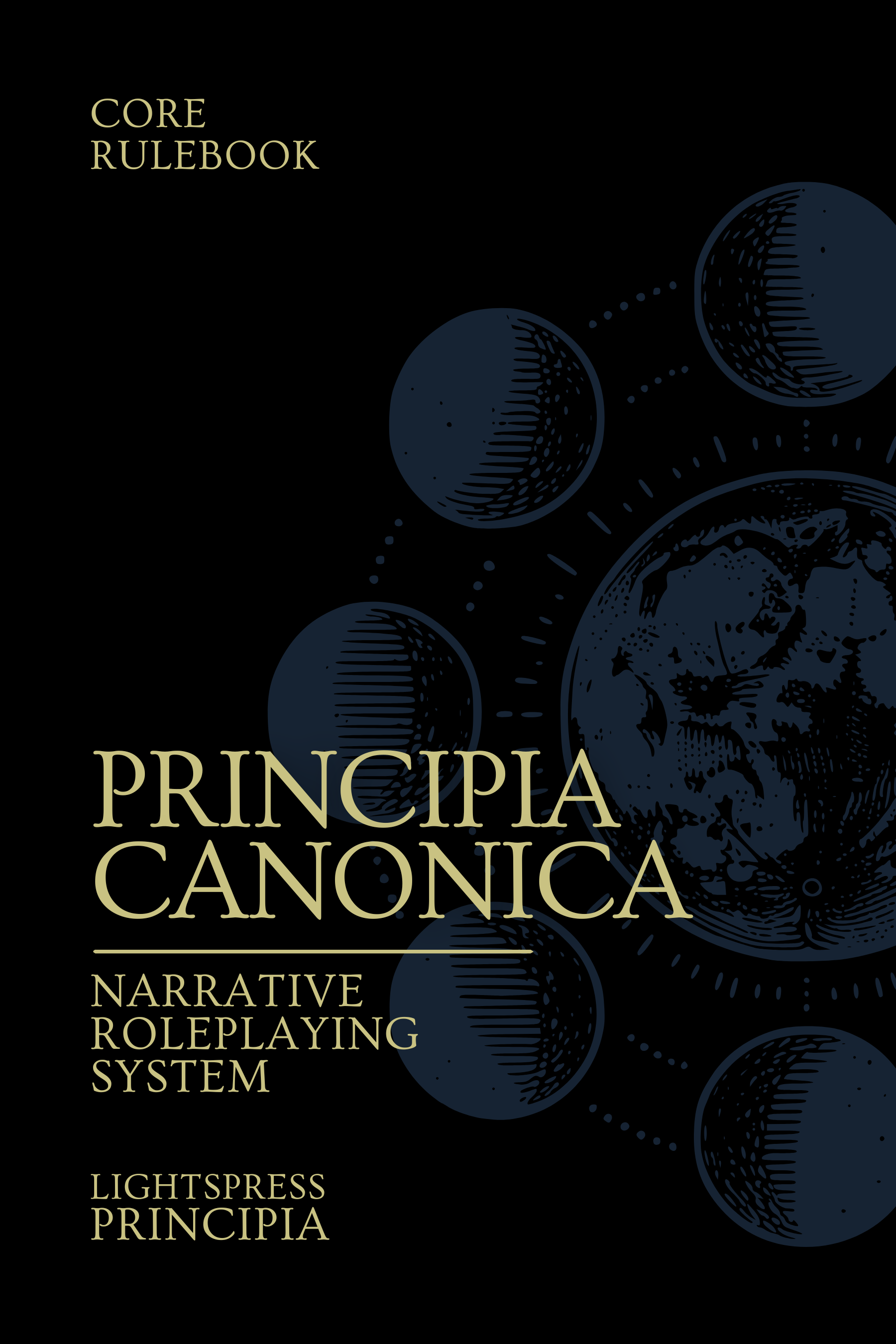
223 pages. PDF and EPUB files included
Principia Canonica is a narrative roleplaying system for groups who want their characters’ decisions to drive the story. Instead of relying on predetermined plots or tactical encounter design, the game begins with an unstable situation in the world that demands response. Player characters pursue their goals as pressures build around them. Events slowly escalate, until conflict reaches a decisive turning point that reshapes the setting.
Play begins with a condition that can't remain as it is. The characters respond according to their traits: Archetype, Identity, Strength, Weakness, and Drive. Their actions increase or relieve pressure, and each result produces consequences that alter the situation. As the pressure rises, their options narrow and tensions intensify until opposing forces collide and the world changes in lasting ways. The system provides a practical framework for recognizing and guiding this process during play.
The core book contains the complete rules for the Principia Canonica system. It explains character creation built on flexible narrative traits, a resolution system built around pressure rather than difficulty, and methods for interpreting results as meaningful consequences that reshape the situation. Guidance for gamemasters covers identifying unstable situations, managing competing factions, escalating pressure, and building adventures that develop through player decisions rather than fixed plots or random die rolls.
Principia Canonica is the foundation of the larger line of settings, genre guides, and sourcebooks. All use the same framework, making it easy for players and gamemasters to move between different kinds of stories while keeping the underlying system of instability, pressure, and consequence consistent at the table.