Sale Price:
$1.00
Original Price:
$4.00
On the Proper Use of Magic presents itself as a regulatory chapter issued by the Order of the Magpie and circulated as a matter of public record. The article defines magic as a civic hazard when left unmanaged and a shared resource when governed with care. Its stated purpose centers on preventing preventable harm in place of asserting dominance over magical practice. Language throughout favors procedure, precedent, and documentation, framing magical failure as a matter of safety lapses and unmanaged risk over moral corruption or ideological deviance.
The chapter establishes acceptable practice through classification and not prohibition. Schools of magic receive approval based on demonstrated stability, repeatable outcomes, and integration into surrounding communities. Practices lacking those qualities are designated unstable or unverified in place of forbidden outright. This distinction allows the Order to present itself as a steward of continuity in preference to an arbiter of belief. Innovation remains possible, but only within structures that allow observation, correction, and accountability when consequences spread beyond the practitioner.
Punitive measures follow the same procedural logic. The article outlines graduated responses beginning with oversight, suspension, and enforced instruction, escalating only when repeated misuse or refusal to comply produces measurable harm. Sanctions aim to limit exposure and preserve institutional memory over delivering spectacle. Removal of artifacts, restriction of access, and reassignment of practitioners appear as administrative actions in place of moral judgments. The text repeatedly stresses that most magical disasters arise from secrecy, isolation, or urgency, conditions regulation is meant to reduce.
Written as an in-universe document, the chapter adopts the tone of a long established ordinance and not mythic decree. That restraint allows it to function across heroic fantasy settings without reliance on a specific cosmology. The Order may exist as a council, archive, tribunal, or traveling authority, with local powers adapting or resisting its guidance. In play, the article supports conflicts around responsibility, contested oversight, and the cost of unregulated power. It provides structure for stories that treat heroism as stewardship in place of conquest.
About the Order of the Magpie
The Order of the Magpie is a multiversal fellowship dedicated to preservation rather than conquest. Moving through the brack, it treats worlds as oysters and what’s worth saving as pearls, including artifacts, species, cultures, and knowledge at risk of loss or misuse. The Order intervenes carefully, recovering without plundering and protecting without ruling. Known by different names across genres and settings, its unity remains deliberately ambiguous. Where freebooters take and vanish, Magpies stay long enough to understand consequence.
On the Proper Use of Magic presents itself as a regulatory chapter issued by the Order of the Magpie and circulated as a matter of public record. The article defines magic as a civic hazard when left unmanaged and a shared resource when governed with care. Its stated purpose centers on preventing preventable harm in place of asserting dominance over magical practice. Language throughout favors procedure, precedent, and documentation, framing magical failure as a matter of safety lapses and unmanaged risk over moral corruption or ideological deviance.
The chapter establishes acceptable practice through classification and not prohibition. Schools of magic receive approval based on demonstrated stability, repeatable outcomes, and integration into surrounding communities. Practices lacking those qualities are designated unstable or unverified in place of forbidden outright. This distinction allows the Order to present itself as a steward of continuity in preference to an arbiter of belief. Innovation remains possible, but only within structures that allow observation, correction, and accountability when consequences spread beyond the practitioner.
Punitive measures follow the same procedural logic. The article outlines graduated responses beginning with oversight, suspension, and enforced instruction, escalating only when repeated misuse or refusal to comply produces measurable harm. Sanctions aim to limit exposure and preserve institutional memory over delivering spectacle. Removal of artifacts, restriction of access, and reassignment of practitioners appear as administrative actions in place of moral judgments. The text repeatedly stresses that most magical disasters arise from secrecy, isolation, or urgency, conditions regulation is meant to reduce.
Written as an in-universe document, the chapter adopts the tone of a long established ordinance and not mythic decree. That restraint allows it to function across heroic fantasy settings without reliance on a specific cosmology. The Order may exist as a council, archive, tribunal, or traveling authority, with local powers adapting or resisting its guidance. In play, the article supports conflicts around responsibility, contested oversight, and the cost of unregulated power. It provides structure for stories that treat heroism as stewardship in place of conquest.
About the Order of the Magpie
The Order of the Magpie is a multiversal fellowship dedicated to preservation rather than conquest. Moving through the brack, it treats worlds as oysters and what’s worth saving as pearls, including artifacts, species, cultures, and knowledge at risk of loss or misuse. The Order intervenes carefully, recovering without plundering and protecting without ruling. Known by different names across genres and settings, its unity remains deliberately ambiguous. Where freebooters take and vanish, Magpies stay long enough to understand consequence.

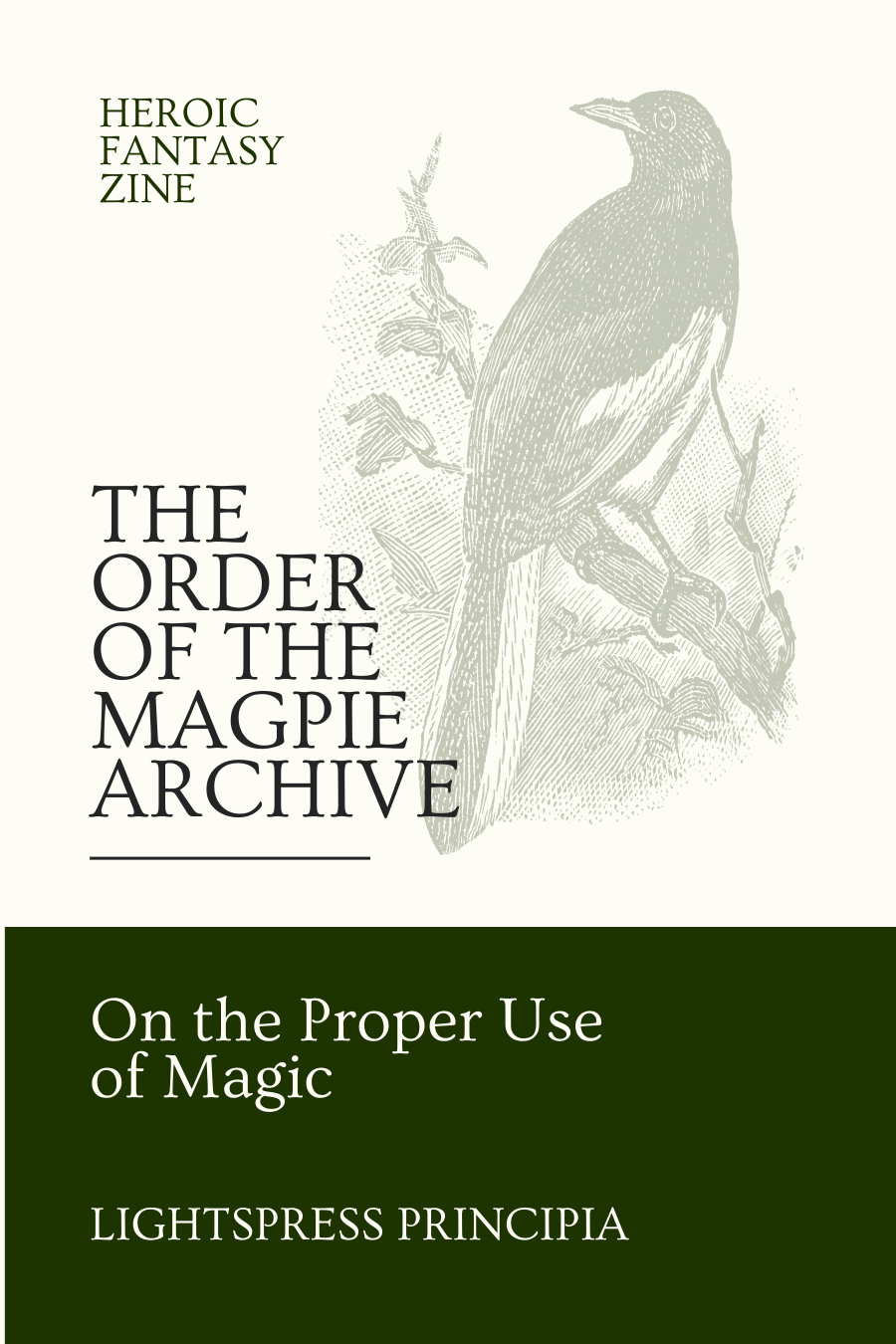 Image 1 of 1
![Order of the Magpie [Legacy Edition]](https://images.squarespace-cdn.com/content/v1/65b16959d3fcc741e08a13c8/fa71ba94-0777-4b6a-85d7-54d9a5387226/ORDER+OF+THE+MAGPIE+LPS250305.png)